
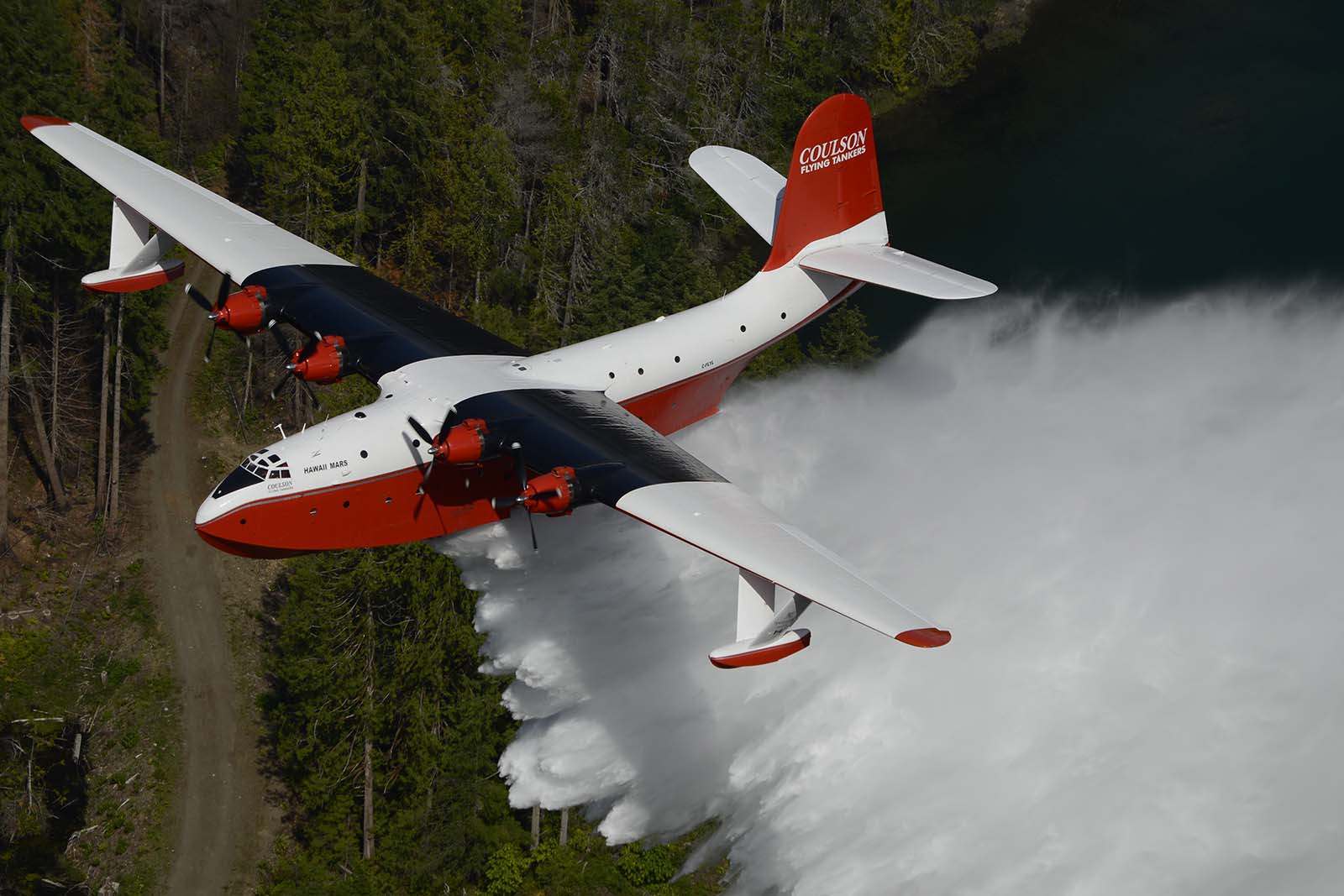
While I don’t know if I’ll ever see humans land on Mars, I did get to see Mars land on Earth. No, really. The JRM Mars, built by Martin Aviation, with the initial drawing starting around 1938 and production going from 1942 to 1947. In that time only seven were built. That’s because these were massive cargo planes — the type of plane that set a new distance or weight record every time it flew.
Their biggest job for the US Navy was getting troops and cargo from the US west coast out to Hawaii, then to the many islands we were fighting from or on. The prototype (named “The Old Lady) was scrapped at the end of the war and another (named “Hawaii Mars”) sank after an emergency landing on Chesapeake Bay.
Another plane, “Marshall Mars,” caught fire in the air and then burned and sank completely after an emergency landing off Oahu, but the remaining four served on after the war, mostly ferrying people and cargo to Hawaii from the San Francisco Bay. In the late 50’s the days of the big flying boats were over and the airframes were left on Mare Island northeast of San Francisco.
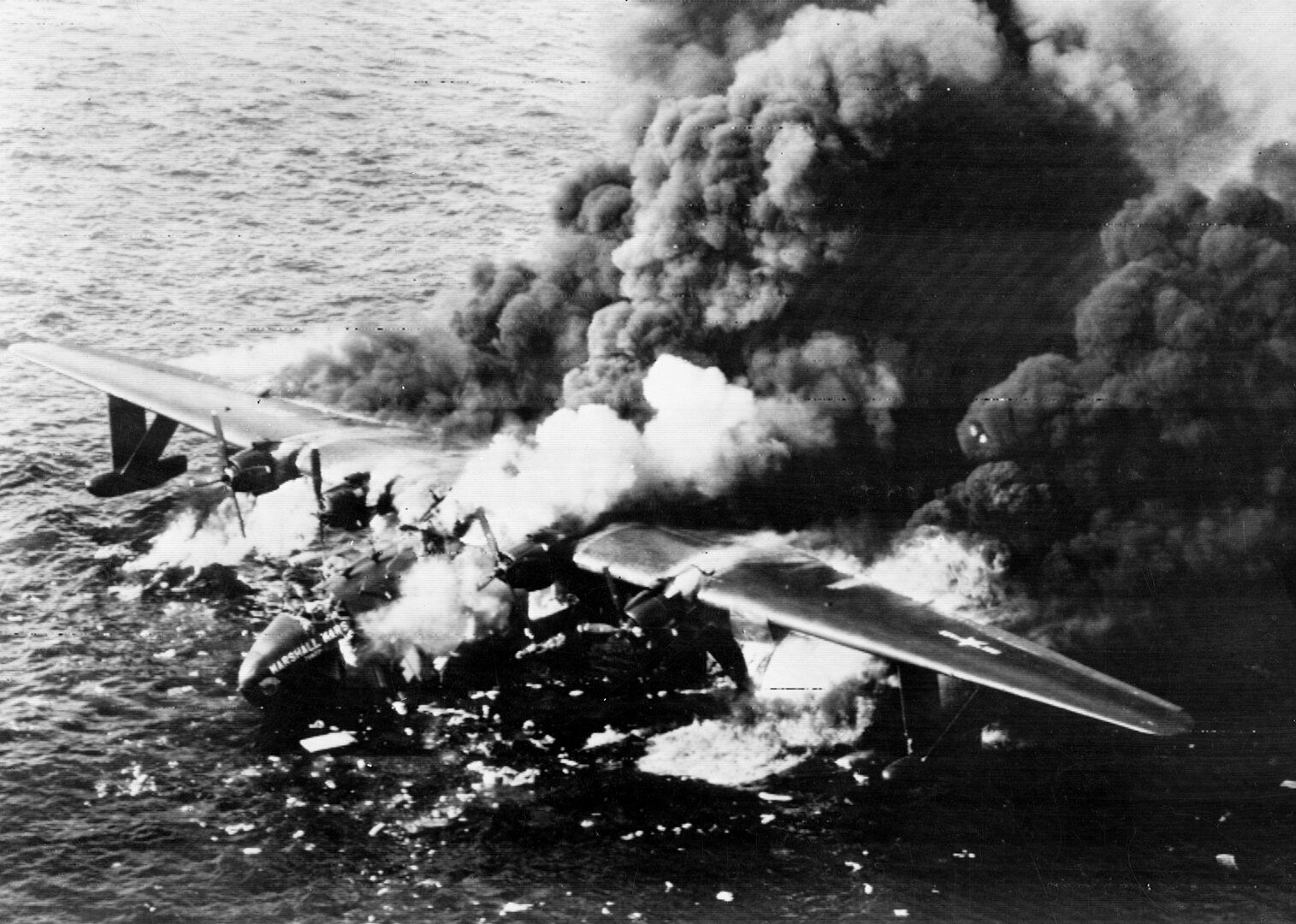
Marshall Mars caught fire in the air and made an emergency landing, but the crew could not save the plane before it burned completely and eventually sank off the coast of Oahu. Photo: Wikimedia.
They were bought as a lot in the 1960’s though in an ambitious project. They were put in flying shape and made it to Patricia Bay on Vancouver Island, where they spent additional years being converted into water bombers. No one had built aerial firefighters of this size before, but with the ability to scoop up 4,000-6,000gal of water at a time (there were different configurations, some carrying more fuel and less water) from lakes and head straight to a forest fire, it was a solid bet these planes could make a solid dent each pass.
And they did. From the 1960’s until 2015 they saved hundreds of homes, millions of dollars in timber, and hundreds of lives. The echo of 10,000HP coming into a narrow canyon was music to the ears of fire crews battling blazes in remote and dangerous locations.
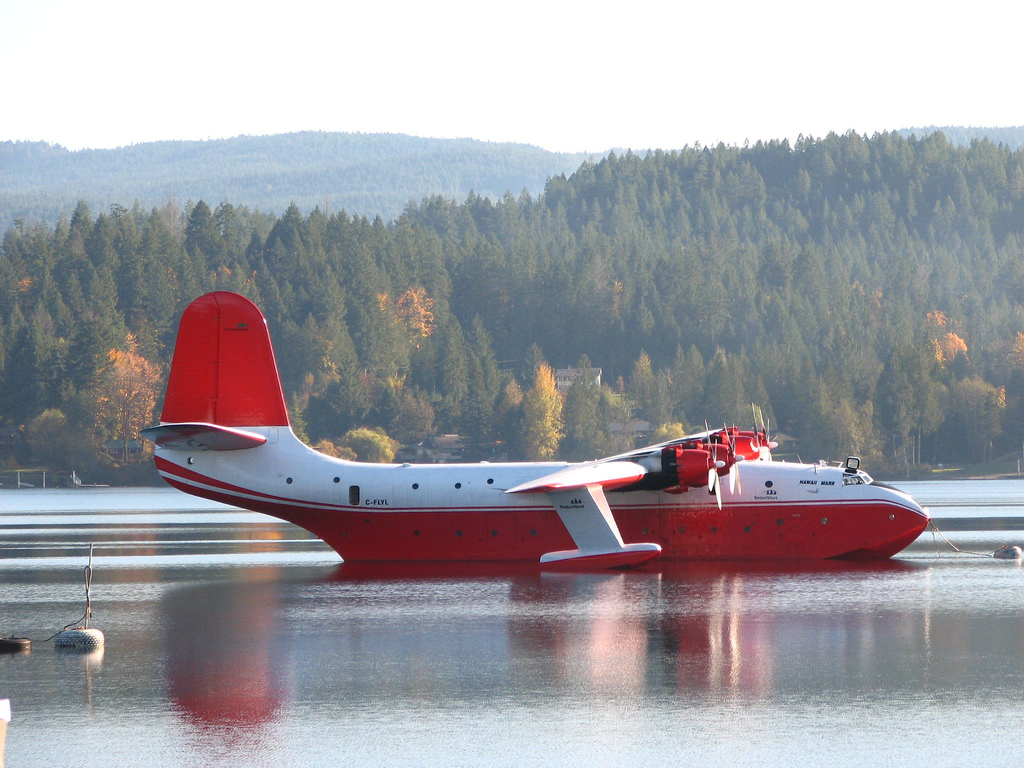
Hawaii Mars at her mooring on Sproat Lake in 2006, still primed and ready to fight. Photo: Wikimedia.
Sadly, “Marianas Mars” was lost in 1961 when the water drop mechanism failed to fully open, leaving the plane too heavy to climb over mountains it was working in. It disappeared in the smoke before colliding with the mountain and killing all four crewmen. In 1962, “Caroline Mars” was ripped from its mooring on Sproat lake during typhoon season and pushed ashore by winds. The damage was significant and the aircraft was scrapped.
That left “Hawaii Mars II” (usually just called Hawaii Mars by this time, or by its tail number C-FLYL)j and “Philippine Mars” to carry on duties. They fought fires all over British Columbia, California, Mexico, South America, and even Australia. The two were re-engined with more powerful radial engines and given state of the art technology to see through smoke and deliver with great precision despite their lumbering appearance in the air.
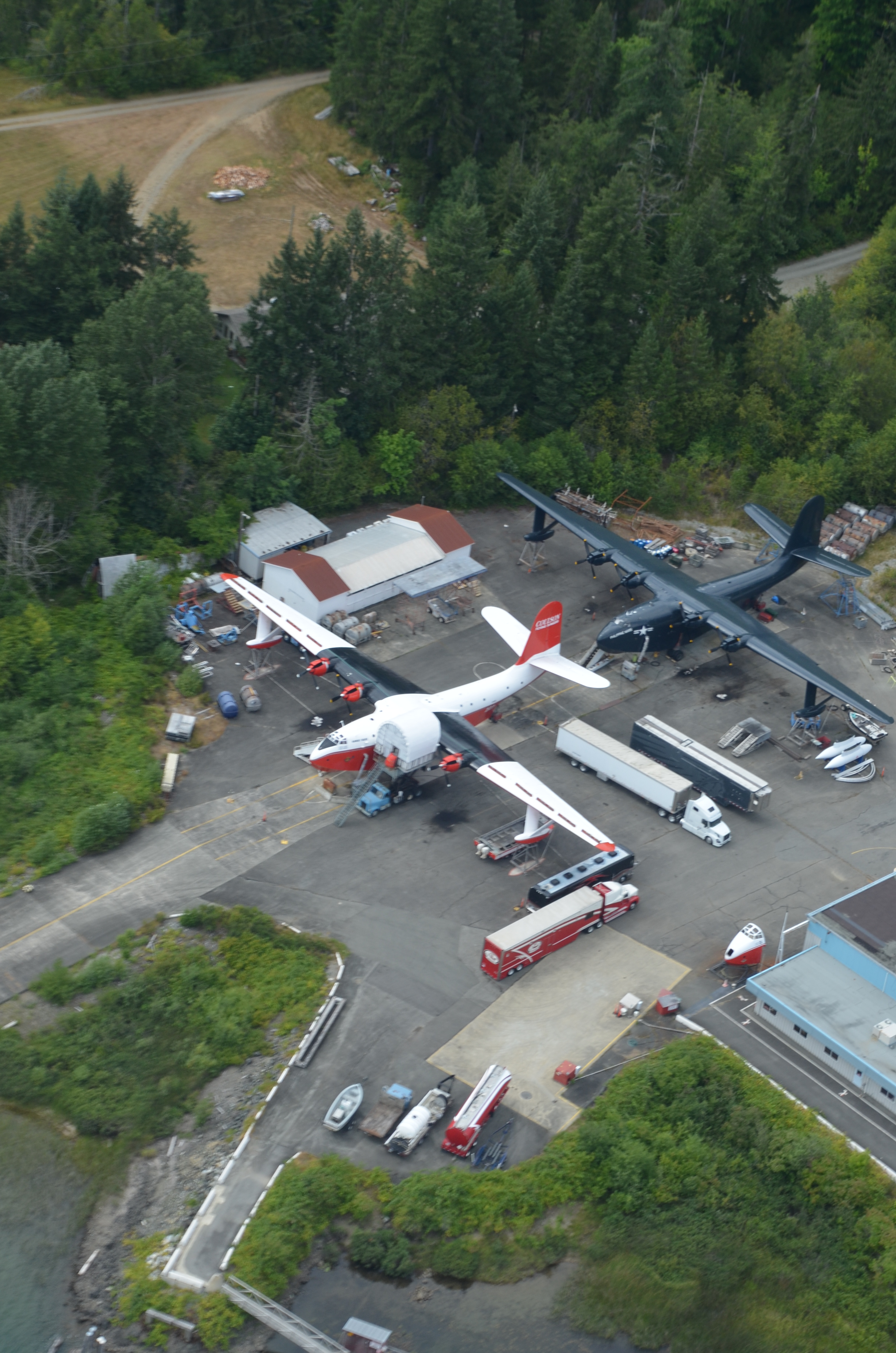 Hawaii Mars and Philippine Mars (repainted in its US Navy colors) sit on the ramp at Sproat Lake. The truck with matching paint near Hawaii is a mobile command center, which worked on the ground to coordinate operations, along with a guide aircraft that would lead the way on runs into the smoke.Photo: Coulson Aviation.
Despite still being in fighting trim the government eventually decided it would be better to have dozens of small water bombers than one or two huge ones. The planes sat out the fires for about three years before public outcry in 2015 caused the BC government to activate the planes for 30-days. Attempts were made to find a buyer, but nothing materialized and the planes were pulled up onto dry land.
That would be the end of the story except that a deal was struck to donate Hawaii Mars to the British Columbia Aviation Museum, based at Victoria airport, which happens to be where the seaplane base is located: the same place the airframes were converted for water bomber duty. It was decided it would be cheaper to put Hawaii Mars back into flying condition and deliver it to the seaplane base than to disassemble and move it from Sproat Lake.
The Lady Leaves The Lake
It was bittersweet then when people around Sproat Lake heard the unmistakable roar of 10,000HP come to life. The sound marked the beginning of the end — the end of a successful and proud career of a very unique airplane. Hawaii Mars was gently put back into the water and its engines run up, systems checked, and the 4-person crew refamiliarized.
It spent a few weeks doing high speed taxi runs on the lake, then finally a proper check ride. But on August 12, 2024, Hawaii Mars lifted off of Sproat Lake for the last time. Due to the cost involved, there was no reason just to “puddle hop” over to Patricia Bay. It was time for a proper farewell.
Hawaii Mars flew for over three hours, waving goodbye to the many communities it saved and defended for over 45 years. Not too far away were the Canadian Snowbirds (Canada’s precision flying team, similar to the American Blue Angels or Thunderbirds) were performing at an airshow, so in proper fashion nine of their CT-114 aircraft escorted the massive plane along.
My recollection
I was there on the shores of Pat Bay with several thousand people to witness its final pass. I got there around two hours early and was lucky I did, as parking was already filled up and lining the coastal road. I took a few pictures of the crowd, and met one woman whose father had been a mechanic on the Mars before retiring. She recalled running around the flight deck of the plane while it sat on Sproat Lake, and still had the large scale-model her father was given as a retirement gift.

I heard a few volunteers from the museum talking about the effort it took for an all volunteer staff to even get a line of communication between them and Coulson Aviation, the current operators of both Mars aircraft. There were stories of retired firefighters being trapped by flames when the Mars came in and cleared a path with a single drop, not only quenching the flames but knocking trees down with the power of 7,000 gallons of water.
In short, it wasn’t just aviation enthusiasts who were there; the Mars was a fixture of the community. Children were there to see it, being told stories from their parents about watching the planes at work when they themselves were children. Old faces were there remembering the early days of ambitious effort required to prove the Mars could even do its job.
And then there was me, waiting to see history be made, one last time, by an aircraft that made a career of creating historical moments. From the days setting new records for time, distance, or payload, to its days knocking out blazes in distant mountains and smoke-filled canyons, this would be the last time a Martin Mars would be heard thundering through the sky.
And there is was. At first I didn’t hear it because they were so low, but people on the shore were beginning to stand up and raise their cameras. Then the faint noise of radial engines, which make a very distinct noise. Then around the bend it came, honestly not showing its size because it moved in a rather light and almost graceful manner.
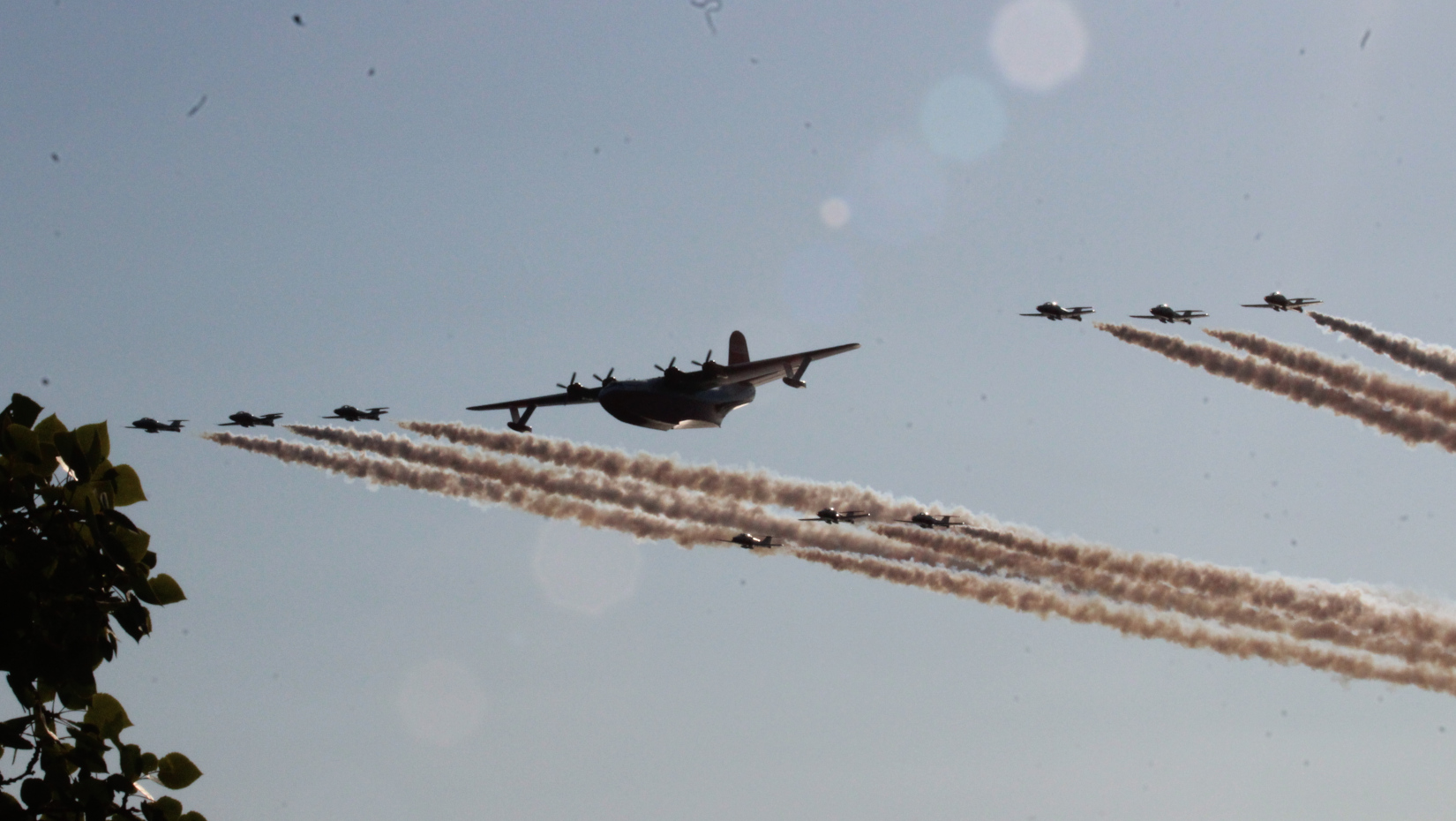
It reminded me of the hippo ballerinas in Disney’s Fantasia. Flanked on each wing and trailing behind were the Snowbirds, trailing white smoke, but you couldn’t hear the jet engines as the Mars came closer. It was over 1,000ft away and probably 200ft in the air but it still vibrated in my chest.
For all the efforts of the crew, I can say it was worth it. The plane looked absolutely brand new and gleamed in the low sun as it passed. The schedule called for about another 30min of it heading down to Victoria, then up the eastern side of the coast before buzzing us once more. When it passed over this time — in the other direction — it was several hundred feet further away, but getting the back end of the propellers and engine exhaust noise was still special.
Then it made a graceful turn over Pat Bay, leveled its wings at us, and began to descend towards the water. Seaplanes don’t really have a “touchdown” moment like land-based planes. Instead of flaring, nose in the air, and plopping down on their wheels, a seaplane “flies onto the water.” That means there really isn’t a picture I can share of its final moment in the air.
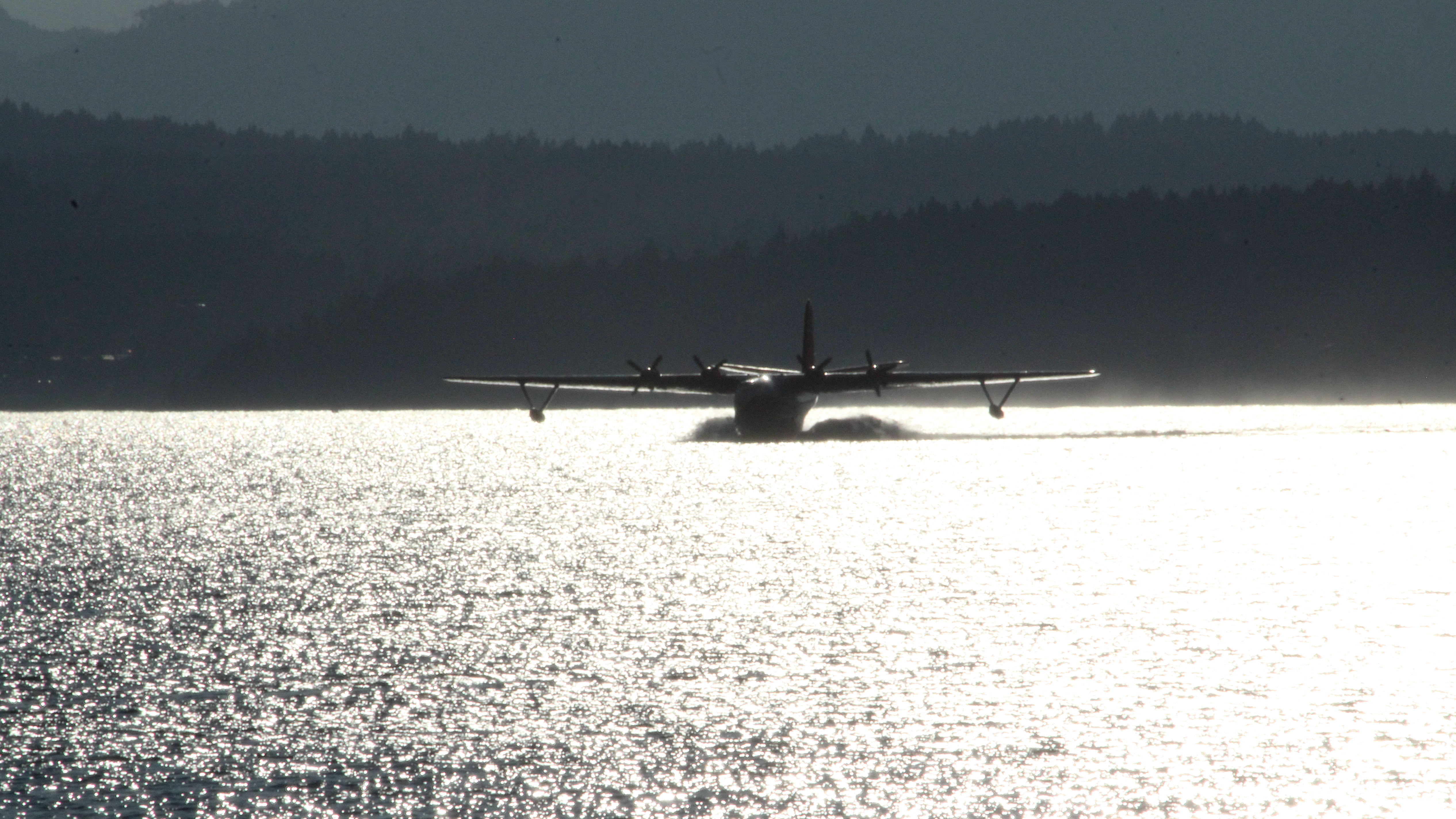
Hawaii Mars essentially touches the water, and as more wight is borne by the water, less weight is on the wings. It continued on like that for quite some time before you could see it visibly start to settle into the water, more boat than airplane now. The Snowbirds made another pass, the crowd cheered and clapped, and a saddened sort of hush fell over the crowd.
Some people left, but myself and many others waited the long minutes it took to fasten Hawaii Mars to its mooring. The hardest part of flying the Mars is said to be parking. Though it floats almost weightless on the water like any boat, it also has wings that span wider than the plane is long. At a standstill, the engines need to be powered one at a time to swing the plane one way or the other, without pushing too far forward and risking running aground.
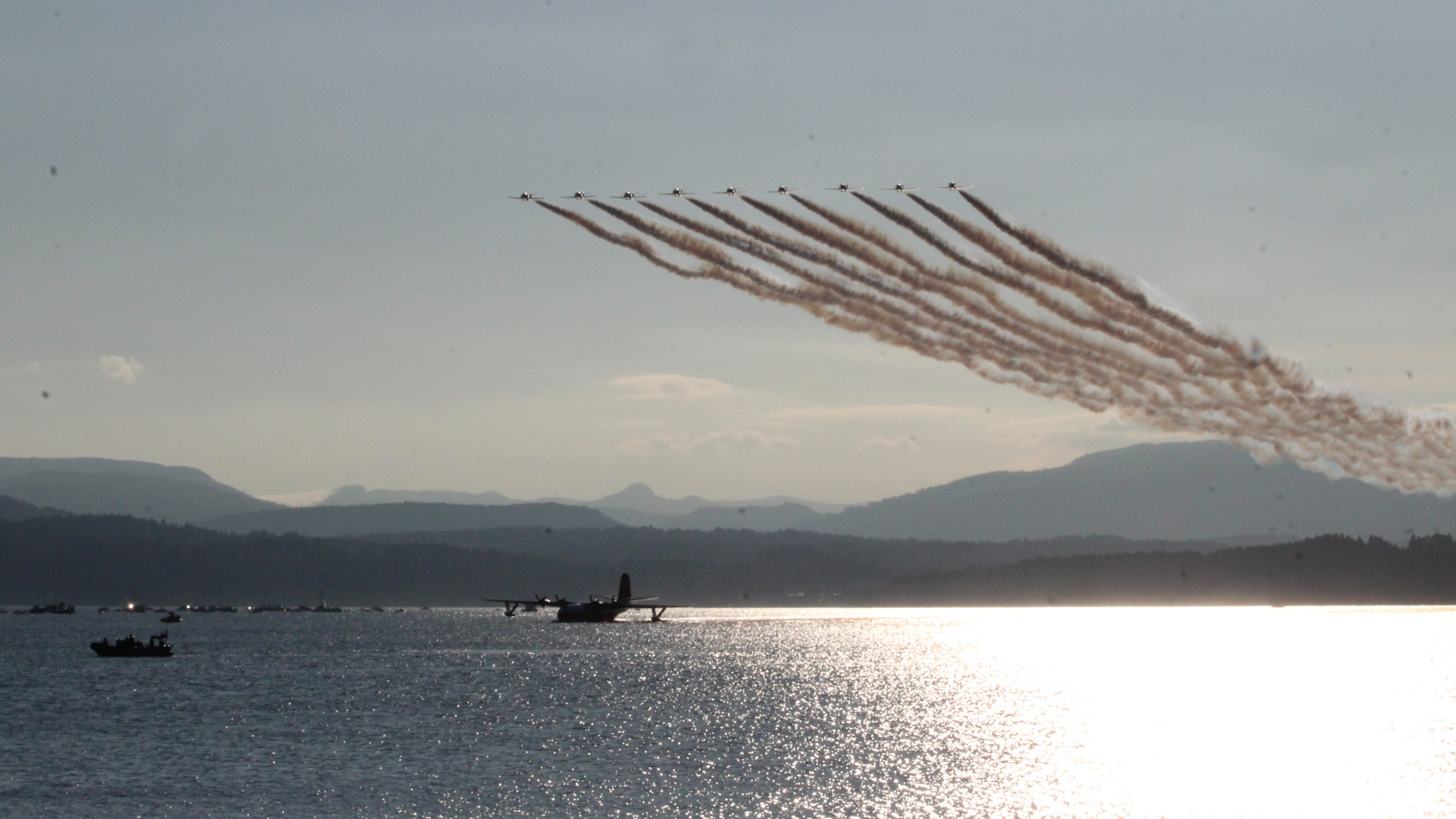 Final salute by the Snowbirds as Hawaii Mars taxis in.
A crewman comes from a hatch at the top of the nose — almost four stories high — and uses a long gaff to hook the mooring line and bring it up to the nose and attach it. The current eventually swings the plane so its nose is facing us. Usually the pilots turn off two engines and use the other two for this maneuver. Either because they needed to burn off fuel, or perhaps for dramatic effect, they left all four fans flying.
When all four engines shut down simultaneously, another round of applause, and another sad silence. The era was officially over.
Eventually Hawaii Mars had her beaching gear reinstalled and she was pulled up the ramp onto dry land. Pat Bay opens to the sea so an entire day was spent “dewatering” the plane. It will soon be moved across the road, then across the runways of Victoria International Airport, through some fences and power lines that must be moved, and into her final home.
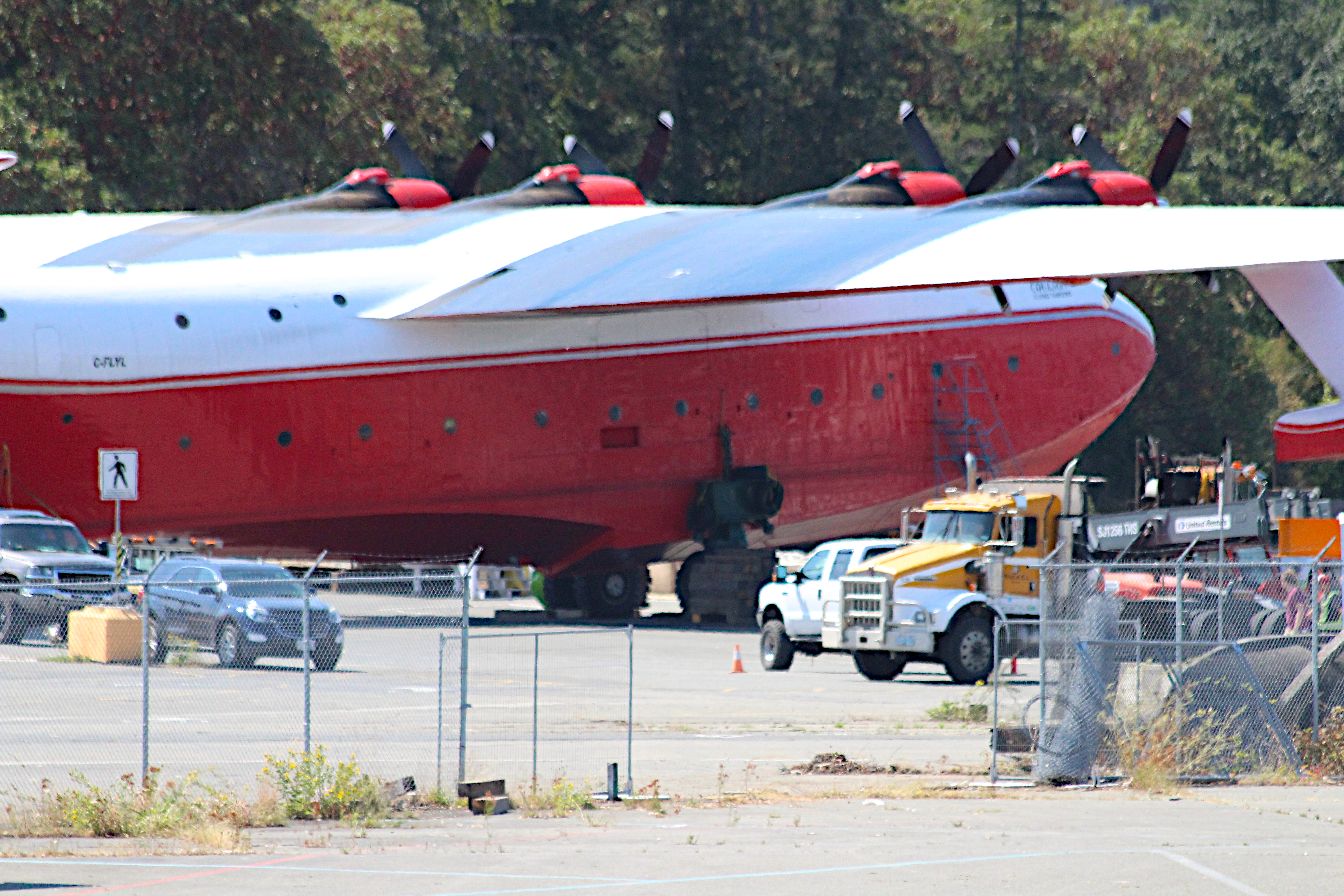
On its beaching gear, out of the air and our of the water forever, Hawaii Mars awaits its next and final move.
Philippine Mars does remain at Sproat Lake, and was even hauled into the water at one point for photos, but the aircraft is considered too expensive to be put back into flying condition without a contract to fight fires. It has also been repainted in its wartime US Navy colors. The Pima Air & Space Museum in Tuscon, Arizona will eventually receive that aircraft. Although the desert is an odd place to find a flying boat, it is actually a rather apt location.
The museum is adjacent to “The Boneyard,” where the US keeps aircraft for long-term storage or for spare parts (cannibalization). That’s because the ground it naturally firm and the dry air helps prevent corrosion. The museum is also a home to giant aircraft. The B-36 Peacemaker is an absolutely massive Cold War bomber that dwarfs the Mars, and there is one at Pima.
The B-52 Stratofortress (a plane still in service actually) is also a large bomber from the area, and they have two. They have large airliners and cargo planes, airborne early warning planes… you name it. But Philippine Mars will be sectioned into pieces and trucked all the way down by a private company that specializes in those heavy haul, oversized moves.
For me though, I’ll remember Hawaii Mars. The planes made a real name for themselves as waterbombers. I can’t think of a single military plane that got more famous after it was put to civilian use. Many other bombers did firefighting, flew as corporate planes, did crop dusting, weather reporting and storm chasing…these were surplus planes sold for pennies on the dollar.
Photo: Coulson Aviation Group.
The Mars served with distinction — both during war, during peace, and in civilian life. I think more to the point, the Mars was still able to do its job. NASA had certified the airplanes before California awarded them a contract and the planes were said to have less wear than a 10yr old commercial airliner. Most metal fatigue happens during landing, taxi-ing on the ground with full fuel, or during pressurization. Mars did none of those things.
Bittersweet, but I’m glad the aircraft will be available for public viewing instead of sitting in a fenced lot, waiting for a contract that will never come. For my part, I had to slog 600-mile days through the desert, 1,850 miles in all, to make it there. It was worth it though. I’ll remember the last flight of the Mars, the Queen of Sproat Lake, forever.
 Johnny Killmore
One thought on “Mars Landing: the Queen of the Lake’s Last Flight”