
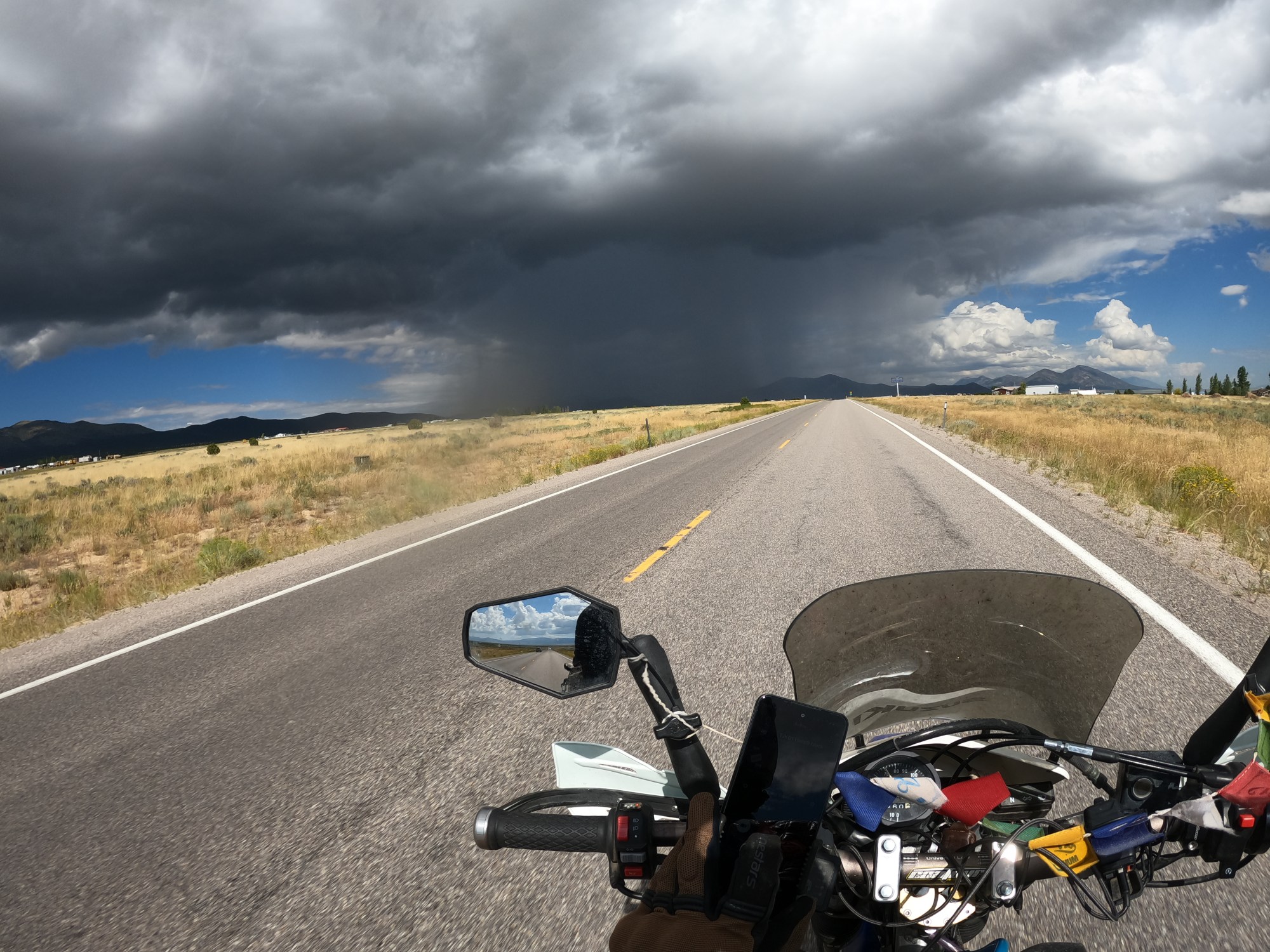
Well now I’m in California. It wasn’t the plan to be here for several more weeks. I still had so much of Colorado to explore, but I got word that my cat was deathly sick, and I had to drop everything and go see for myself how bad things were. I still tried to make the best of things, so I made a few stops as I rode the 1,ooo miles of “The Loneliest Road in America,” Highway 50.
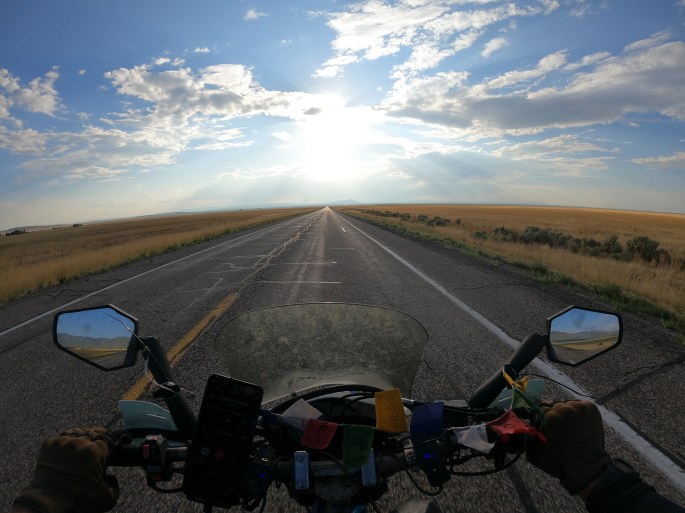
Highway 50 runs from Sacramento to Washington DC, but the stretch through Utah and Nevada is very straight and mostly flat. It follows a portion of the Pony Express route, which is also where the Butterfield Overland stagecoach northern route followed, which was in turn eclipsed by the railroad.
Fortunately the weather was very mild for August, as Hurricane Hillary’s leftover energy was moving north, sending cool air and rainstorms over the harsh desert.
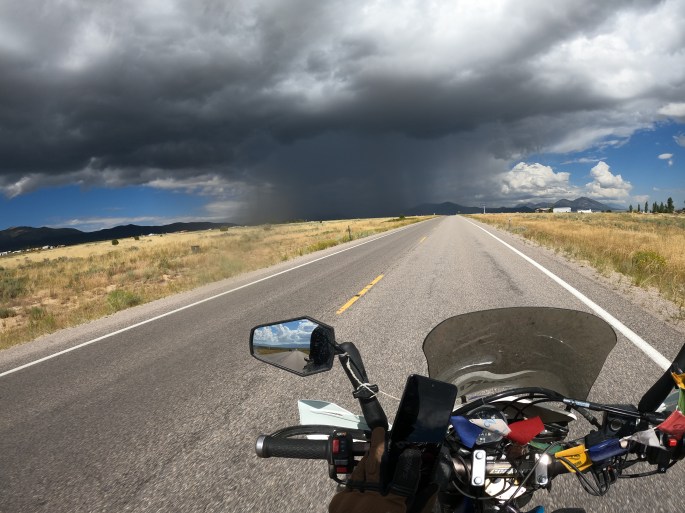
On the downside that meant dodging rain, or sometimes just riding through it.
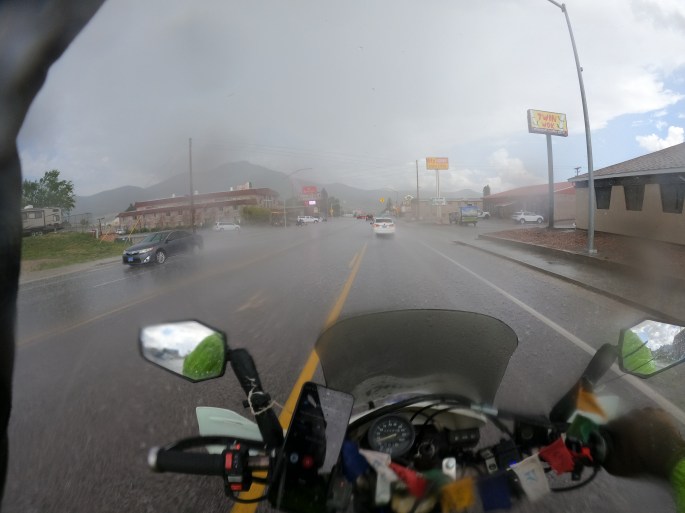
On my first night I made it through a lot of nothingness and some small leftover towns still surviving after time had passed them by. The town of Deseret was once a series of homesteads, but American Indians weren’t happy with the encroachment, and the locals had to “fort up.” The result was Fort Deseret, which was mud and straw but enough to allow the locals to defend themselves. The fort was later used as a livestock corral. Nowadays Deseret still survives because of irrigation and soil fertile enough to grow corn and other animal feed.

My first night was spent on a dry lake bed. At least three different storms kept flashing lightning well into the night, but only a few drops actually fell on me. The song “Riders on the Storm” by The Doors played in my head as I set up camp.


The night was peaceful, but something had gotten into my eye during the ride that day and I couldn’t flush it it out. I finally gave up and in the morning my eye was nearly swollen shut.


There wasn’t much I could do, so with a watering and blurry eye I continued westward.

The slower pace of the DR650 meant seeing things in a new way. The scenery was unusually green for August, and the few lakes were quite full. The dry lakes also weren’t totally dry.
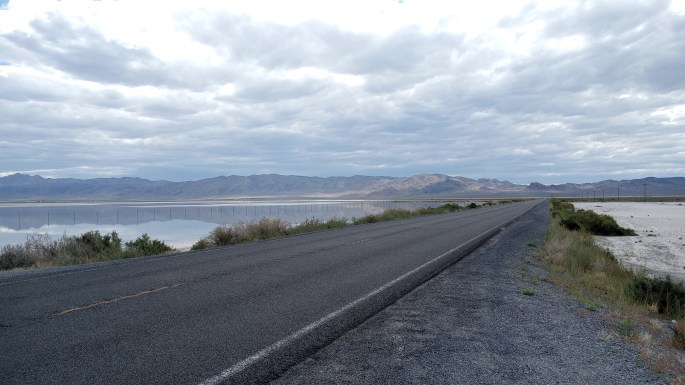
In Nevada I stopped to see the ruins of some of the stagecoach stations for the Butterfield Overland. John Butterfield took the contract to deliver the US Mail knowing it wouldn’t last long: the railroad would eventually be completed. He built the route nearly from scratch, bought coaches and horses and mules, cut roads, and hired men to operate the stations, which were located at intervals of 12-30 miles depending on the terrain.
Eventually he bought the Pony Express contract too, moving them onto the Butterfield route. At one point on Highway 50 there is a Pony Express station and a Butterfield station only about 2-miles apart. within a few thousand feet are also the ruins of a telegraph station — another project of immense effort that only lasted a few years before being eclipsed by both the railroad and wireless transmission.
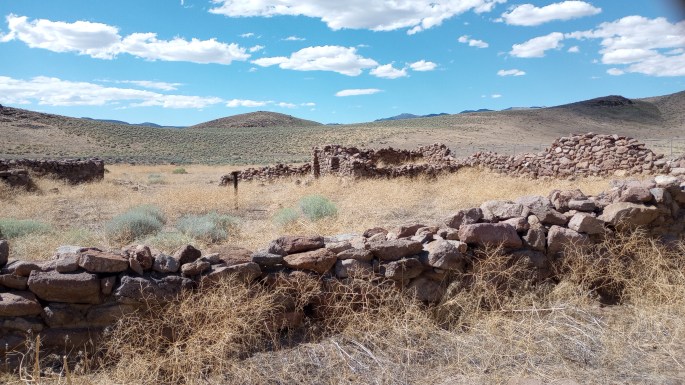
One cabin I noticed had no signs and was sitting abandoned on private property, right next to the overgrown and crumbling asphalt of the original Highway 50, which was right next to the current one. At first I thought it might be a Pony Express station, but the bricks and stones looked different. Then I noticed the roof was actually made of old rail ties, which would date it well after the rail line was complete (assuming it was the original roof of course).


I was stopped in my tracks when I met up with I-80 between Fernley and Reno. A wreck had blocked all lanes, and I decided to drop back down to Highway 50. That meant heading through Lake Tahoe instead of the Donner Pass, but both options are beautiful just the same. It added hours to my trip, but it felt more productive than sitting in traffic.
Eventually I made it back to the San Francisco Bay, checked into a hotel, and met up with my cat. Kidney disease is likely to get him soon, but what was causing him pain was his GI tract, but the old fella got a colon cleanse to the tune of $750. Not exactly a spa day, but he already went from being unresponsive to eating food and asking to be pet.


I had to relocate east to Vallejo where motel rates were lower, so on the way I stopped at Mare Island, This was a Naval base for over a century, and when it closed in 1996 it did what all military bases do when they close: it got whored out. There were some housing developments for the wealthy, a few old buildings repurposed for the poor, an Army Reserve center, plenty of companies doing marine work in the old warehouses, and of course a hipster brewpub trying its best to be gritty by locating itself on a wharf.
Old ships were there as museums, modern ones looked to be getting repairs, and of course there were rows of barracks and storehouses with no trespassing signs. One thing that was a bummer though was the base cemetery. There were graves of sailors and Marines, gunners and surgeons, admirals and seamen, as well as wives and children. Among them were at least two Medal of Honor recipients.


While beautiful in its location, the lack of maintenance was shameful. People were leaving flags and other keepsakes, but a weed-wacker hadn’t seen that grass in a year at least. The city of Vallejo is responsible for the island, but honestly I don’t care who owns the land: the US bears responsibility for remembering our veterans. This isn’t a section for veterans in a private cemetery; it’s a military cemetery on a military base.
On a related note, I took a foray to see Colma, which is known as having more dead residents than living. That’s because San Francisco literally kicked out its dead in the early 1900’s, making room for land development that didn’t involve being built on a cemetery. You could easily spend months walking the miles of adjacent cemeteries, but I only had an hour or so. Before heading down there I went to another grave though: the wreck of the Garden City.
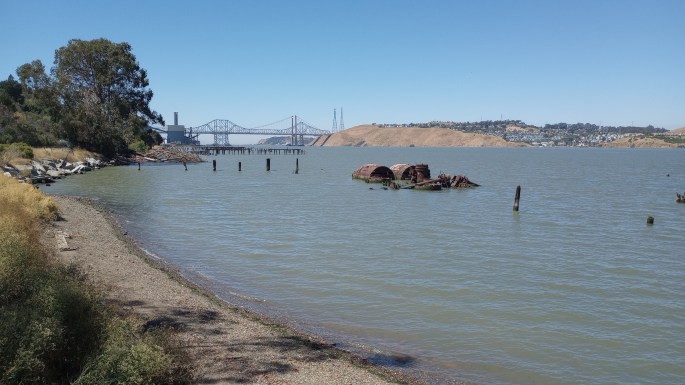
It was a ferry that worked from the 1850’s until 1929. It lived at its final resting place as a sport fishing resort until the 1960’s when it was abandoned totally. A brush fire reached the shoreline in the 1980’s, burning the ship to the waterline. What remains visible are the boilers and the gearing that spun the paddle wheels.
I also stopped off at Yerba Buena Island, also known as Treasure Island. It was a Naval training facility as Yerba Buena Island (called Goat Island back then). Land was added for the World’s Fair, which then became Treasure Island and part of the Naval base. It lives now as a nonstop project to — you guessed it– build condos for rich people, put poor people in the asbestos-ridden original buildings, and let brewpubs and wineries steal some street cred from the old buildings.
The one thing I really like about the place are the iconic buildings. The chapel, the hospital, and Officer’s Row: houses built for senior officers and their families. One of them was Admr. Chester Nimitz’s home. He was actually invited back to occupy the home after retirement: something that doesn’t happen. But this is Nimitz we’re talking about: the guy who led the entire Pacific Fleet to victory against Imperial Japan. He lived out his days at the home, dying there in the 1960’s.
Now the home remains, but the new Bay Bridge hangs right over it, creating an eerie shadow that juxtaposes the old world with the unstoppable march of modern life.

As for Colma, as I said you would need months. There are so many hundreds upon hundreds of markers. Entire rows of mausoleums compete for your attention. I included William R. Hearst’s simply because it’s right at the entrance, is freakin’ huge for just one person (or for 30ppl), and I know the Hearst name because of how many damn newspapers and magazines he owned. You may also recognize the name Patty Hearst, who got caught in a weird situation and made a massive jackass out of herself, landed in jail, but got dragged out by the sheer cubic dollars her family had. Really sucked to be her, young wealthy and impressionable, when the SLA decided to target her for kidnapping.
Also up was a name most people don’t associate with San Francisco: Wyatt Earp. While he is tied to the name Tombstone, Arizona inexorably, he isn’t buried there or in Dodge City. In fact, he had an open warrant for murder in Arizona ever since the OK Corral shootout and never returned to the state. He continued hunting big breaks and easy money as a prospector and saloon owner in Alaska and California. He died in 1929, working as a sports writer for a newspaper in LA. He had set up a decent life in San Francisco before, but made some enemies (as he was wont to do) and moved to Los Angeles.
Last up was “Joltin’ Joe” DiMaggio, who was within a mile of the aforementioned. I’m no baseball fan per se, but the guy was a legend and deserved a stop by and a tip of the hat.


For now I need to sort out my near-future plans. I was supposed to explore Colorado until September 10, then head to Reno for the final Air Races held their. THEN I was supposed to visit my cat and head down the coast to visit friends in Los Angeles and Orange county. From there I would decide where to go next.
I’ve decided not to return to Colorado until at least after the Air Races. From Reno I can head east or south, and I’ll need to figure it out then. For now I’ll head north and hug the coast, keeping away from any of central California’s ridiculous heat. I may go into the Sierras, chasing some of California’s mining history in the same way I was exploring Colorado.
The important thing is to get the weather right and find ample free camping, as buying my cat a colon cleanse and prescription cat food (yeah, it’s a thing) put me way over budget for the month. Worth it if he stays pain free, but still a big hit.
More adventures to come.

 Johnny Killmore
Cats. Here’s hoping he lives out his days pain free.
I had forgotten about Wyatt Era working as a sports writer. I read a pice on him long ago, in I think The New Yorker magazine. And Joe DiMaggio, I’d have guess NYC. “… where you gone Joe DiMaggio? Our nation turns its lonely eyes to you…”.
Fantastic photos and prose.
The. adventure continues.
LikeLiked by 1 person
Thanks, but that unedited draft makes me outright cringe as far as writing goes. Poor flow as well as the typos, plus photos out of order and even inconsistency with the font. I’d like to give more time; writing is my passion but everytime I get a motel room there’s so much to do, I don’t have time to edit…just post
Yeah Wyatt Earp is interesting when you look at the totality of what he did. Much of his lore was from the ferocious defense his wife Matty gave of him after his death, as well as his many unverified and inconsistent tall tales. He was a very large man who didn’t take any shit, but there’s a lot of conjecture about how much shit he shovelled out himself. Truly a character though.
LikeLiked by 1 person