
How did another week pass by? I must admit, being off the road has allowed me to really shut down, and I have done nothing to get myself going like I’d planned to. Sure, it’s fine to slum it for a week or even two after a long trip but — like everything I do — I’ve taken “doing nothing” to an extreme.
In fairness to myself I’ve earned some down time, and I’ve also managed to do a few things; it just doesn’t feel like work. Most of what has needed done is just buying stuff online. I had to grab a few pieces of furniture to create a living space at this spot I’m renting.
I had to buy bucket-loads of parts for the bike, and had to sort through a lot of things I already had stored here and there. Planning is part of working, but it doesn’t feel like anything is being done until the “real” work starts.
None of my planning involves moving away from a screen though. Planning is work (it gets things done), but doesn’t feel like it (I am sitting in the same place I sit if I want to watch cartoons on Netflix). Now though, things have shown up in the mail.
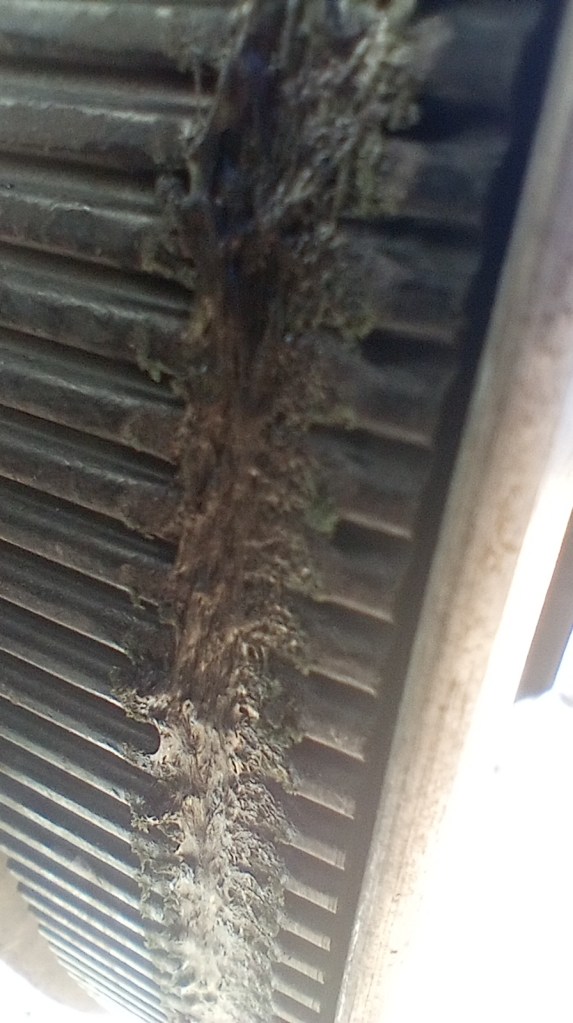
It’s time to start tearing apart the Chieftain. The rear tire — despite being plugged — is leaking as the hole turns into a split. While the wheel is off the bike, I have to pull the swingarm out so I can replace the damaged drive belt.
Funny thing about belts: they require almost no maintenance (a rare adjustment) but when you finally do have to change them… man is it a lot of work. Chains can be broken and reconnected with a master link, but of course they require more adjustment and servicing, while also only lasting 5k-20k miles. A belt usually lasts 100k miles rather easily, but an errant rock got caught and gouged a big ol’ slice out of my 39k mile old belt.
The back end of the bike isn’t the only problem either. The front tire has served me well but is living life like a zombie now — not really alive or dead, but mostly dead. The front forks also need servicing, which means taking off a lot of parts to get at the bolts that hold them in. Fork maintenance is also a messy operation, requiring a lot of cleaning fluids, a lot of clean, flat surfaces, and either special tools or a thick slice of luck.
Techno-trickery is needed too, since both tire sensors for the TPMS (tire pressure monitoring system) need replaced, due to dying batteries. No, you can’t swap out batteries — you have to replace the sensor and use a little magic wand to get the bike’s computer to recognize the new one.
See, they work by sending radio signals to an antenna on the bike, and the bike needs to know which sensor goes to which tire, and of course needs to ignore any other radio signals coming its way. That means a “re-learn” process, which is easy on paper, but wizardry exists in such systems.

New steeds for new horizons?
And damnit, all this work and yet I’m thinking of selling the bike. Yes, it makes the most sense currently to have two bikes: one dedicated to dual purpose riding (the DR650 I already have) and one dedicated to long-haul road riding. While the Chieftain is a great choice for the second job, it does not cover all the bases like you might think.
First off, it’s American made and parts are very expensive — to the point where European brands seem like a bargain. It’s also heavy at about 850lbs, and there are many long-haul machines out there with great performance that weight in at 550-650lbs. The main strength of the Chieftain is that you can point it at the horizon and ride all day.
The weight makes it stable in crosswinds and therefore less tiring. The bike is packed with creature comforts and trip computers and techno-trickery. It is practically maintenance free, with no radiator, no valve adjustments, the belt drive, and 5k mile intervals for oil changes. The thing is, there are other bikes that can excel in different ways, and aren’t too much more work to keep running.
Long, straight roads aren’t really a test of a bike, but of the rider. With no desire to prove to myself that I can ride hundreds of miles while staring off into space, I’d rather own a bike that can carve up back roads, and do an okay job on the boring stretches.
The type of riding the Chieftain is best at — long, straight, flat highway — is the type of riding I hate the most. I search for backroads and mountain passes. That means narrow and twisty stuff, and sometimes bumpy and torn up pavement. It also means plenty of flicking the bike from one side to the other, and that’s where 850lbs is a problem. Stability is the opposite of maneuverability, so what works great on the highway will struggle in the twisting mountain lanes.
That means the idea of a sport-touring motorcycle looks more enticing than a heavyweight cruiser. There’s still enough “oomph” to pull a trailer, but more “sport” when you leave the trailer back at camp. One other nice thing is that sport-touring bikes have largely been abandoned. That makes used ones mega-cheap.
See, everyone wants an Adventure bike (adv), even though most of them are just sport-touring bikes with less plastic and dirt-bike styling. It’s the two-wheeled equivalent of an SUV: it looks burly and ready for action but its job is to run errands and take the kids to soccer practice. Sport touring bikes are more like if they made a grand-touring minivan… like if BMW were to remake the Dodge Caravan so it could haul the family on a long road trip in comfort, but at speed.

Here is a perfect example. Both of these machines are 15+year-old bikes and use the same engine, transmission, and final drive. Left is the Stelvio, and adv bike. Right is the Norge, a sport-touring bike. Stelvio’s sell for about $5,000-$6500. Norge’s sell for about $3500-$4500. Neither is any good off-road. Both are for touring on the road. The biggest difference is the looks, which causes demand to make the Stelvio worth more on the used market.
Other than that…
I could go in depth and tell you what I’m looking at, and maybe in some other post I will. The fact is, I’m still not 100% sure I’ll sell the Chieftain, but I know there is a future project I have planned that will require something different. I have plans to do a big cross-country tour, but to also use that same motorcycle in a race of some sorts… a sort of “one bike to rule them all” kinda project.
The machine isn’t expected to win so I can go with a sport-touring bike; the main goal is that the bike acquits itself well in all realms. Most people don’t understand how different a vehicle needs to be set up when being used for high performance driving. If you take a base model car on a race track you will overheat the brakes within a lap or two. The suspension will bottom out everywhere and the car will feel vague as you try to slide it through turns.

You don’t need a purpose built hyper-bike to go racing at all, but you can’t just use whatever you want. Some “sport” has to be in the design or they are outright dangerous, and I for this project I have I don’t want to sink big $$$ into making a bike track-worthy.
The same can happen with motorcycles, where they can be absolutely dangerous to try and push to their maximum. Heavyweight touring bikes are of that type, and even some sport-touring bikes are. They need things like centerstands and low mount exhausts to allow for saddlebags. Those are hard-mounted metal parts that drag on the ground when you lean into a turn, lifting the bike off its tires and onto something metal.
Trust me when I say: rubber has much better traction than metal.
But this is all to say, I will need a different motorcycle in a year or two. For now, the Chieftain needs maintenance; it is my only ride around town. I need groceries? Take the bike. Going out with friends? Take the bike. It’s snowing? Well, how bad? Can my errand wait until the roads are clear? If not, take the bike anyway.
So, not much in the way of wild adventure right now. Winter is for writing and reflecting, and for planning the next foray. It is a time for ideas, and not for story-making. I am digging through my book project though, intent of doing some story-telling, but the process of remembering where I left off is reminding me how many cobwebs have built up.
Writing a book is nothing like writing a blog post.
You can keep yourself posted on any blog updates by signing up below. That list sends out an email on Sundays, but only if there are new post to share. No spam, no selling to third parties, just an email update when I post something new.
 Johnny Killmore
I have been through the heavy cruiser stage. Now I’m riding a Pan America S. You’re absolutely right about ADV bikes – they remind me of the old “scramblers” in the late 60s and early 70s. I’m 77, 5′-8″and 145# and rode home from Galveston to Mitford SC in 18-1/2 hours (1060 miles). I was a bit wobbly when I got home, but I made it. Average speed was in the 70-80 mph range and fuel was 52 mpg.
LikeLiked by 1 person
Yeah I like adv bikes. Honestly I like sport-touring bikes but always thought “why not get rid of all this extra plastic, drop a little weight here and there, and maybe some longer suspension so when I’m on those beat up, paved goat trails in the mountains, I don’t bottom out?” That’s basically what an adv bike is. In the used market though, sport-touring bikes are SO MUCH cheaper, plus in recent years the OEM’s have made strides in lighter adv bikes, in the 700-800cc range.
Those can do the highway and still get on the trail, so I’d probably be more inclined to go that way if I wanted a “true” adv. Since I have my DR650 though, and it’s got enough comfort mods to do okay on the highway, I’m happy as a clam in the dual-sport department. It can do a 500mi day just fine. The Chieftain can do 500mi days back-to-back without me getting sore, but who wants to really do that kind of riding?
Congrats on picking up the PanAmerica btw. In the end, adventure is an activity and not a category, so any bike can help us go out and find adventures. It can be riding to Patagonia or to the local coffee shop, but either way it will be more exciting than if you were in a Prius.
LikeLike