
The 1960’s spawned a lot of low-budget films. With drive-in theaters there was a big market for them. There was a huge slice of Americans that lived in smaller towns, and the drive-in theater was one of few places you could go and be alone with your sweetheart. For many patrons, what was on the screen wasn’t really important.
But hey, you could get some popcorn or a slice of pizza and a Coke, enjoy a low-budget flick from the comfort of your own car, and so either things were going well enough to steam up the windshield, or you could at least watch a movie; sounds better than failing to score up on Lover’s Lane.
There were plenty of sub-genres like horror films and even major releases like The Sound of Music and My Fair Lady, but the need for a new feature every week gave film makers a chance to hammer out low-budget films. Simple plot, not too many characters needing costumes, no expensive set designs, and not too much in the way of acting.
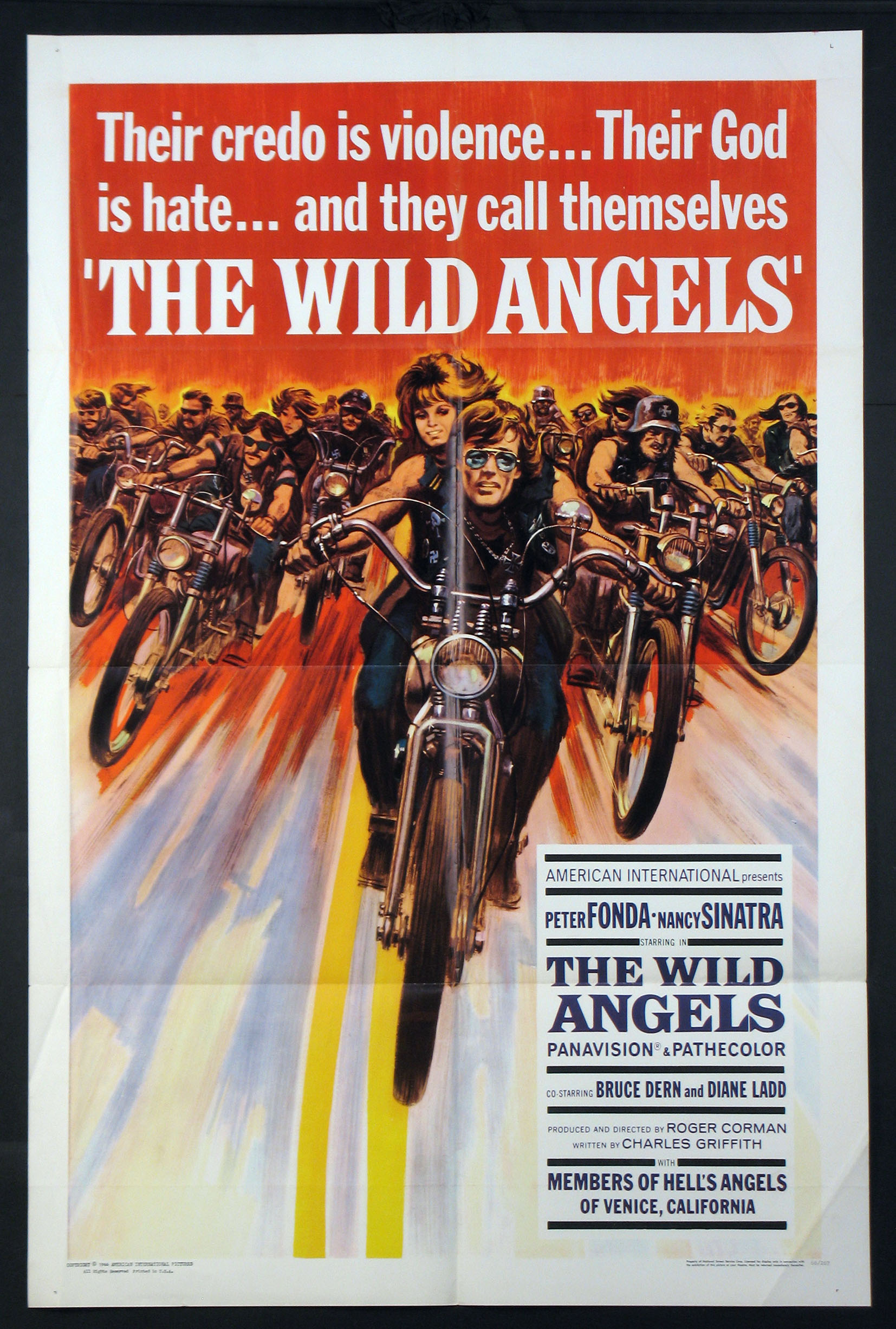
Despite that, one of the best of the 1960’s “Chopper Operas” featured quite a bit of talent. Years before Easy Rider, Peter Fonda played “Heavenly Blues” (yes, really, that’s what they named the main character) in the film The Wild Angels. Leader of a misfit group of bikers from San Pedro, CA, he leads his mob in search of one of their members’ stolen motorcycles. The Wild Angels actually helped associate Fonda with motorcycles, being released in 1966 — three years before Easy Rider.
 Source: movieposters.com
Actual Hells Angels members were used as extras, paid daily both for they and their bike’s appearance: a great budget saver compared to trying to build a dozen or more custom motorcycles and creating a wardrobe budget. Beside Fonda is none other than Nancy Sinatra, playing “Mike” (also nicknamed “Monkey”) and looking as stunning as ever.
Blues’ main partner in crime is named “The Loser” and is played by Bruce Dern, who has a tremendous and decades-long career in Hollywood, despite not many people knowing him by name. He is well-known in the industry for sure. As a working actor, he has major and minor parts in TV and film and is still working (as of this writing he has 10 projects in post-production).
As “The Loser” he plays a perfect rendition of the off-the-cuff style he is known for, often seeming like he is ad-libbing the part as he goes, which gives an unhinged, manic delivery at times. Opposite him is his wife “Gaysh,” played by his real-life spouse from 1960-69 Dianne Ladd. An award winning actress herself, she has a massive list of credits in TV and movies, appearing a few times with Dern as well as their daughter Laura Dern, who is said to have been conceived during shooting for this film.
What makes it special
The film itself does have a cult following. For whatever reason, Easy Rider gets remembered along with The Wild One as the two major biker flicks of the 50’s and 60’s, but The Wild Angels has a major cast, its own soundtrack, Roger Corman as director (an absolute B-movie legend), and enough of a budget not to be a total bomb.
Decades later, looking back, it captures a lot of nostalgia with its B-roll: the establishing shots that don’t have dialogue. The very opening scene takes you down the Pacific Coast Highway, viewing the openness and 100’s of oil rigs along the coastline where it is all resorts and expensive housing now.
The plot isn’t important, in true B-movie style, but it does take the troupe out onto the highways of California, out into the town of Mecca, California, near the Salton Sea and Coachella Valley. Seeing these places in their early-60’s glory is great for someone like me, who has ridden the very same roads. A lot of it hasn’t changed, as the Salton Sea was a failed attempt to make another Palm Springs, and it lives in a state of decay that looks similar now to how it did fifty or sixty years ago.
The opening montage rides the freeways of Los Angeles, which was still full of traffic but is somehow nostalgic just the same. Basically, this movie is good because of its nostalgia, but it actually had some decent writing and great cinematography by B-movie standards.
Spoiler alert: the gang has to take one of their fallen members to be buried in his home town up in the mountains. That also means there’s location shooting in the Coachella Valley, San Pedro and the LA freeways, the California Coast, and the Sierra Nevadas. It also has some pretty legendary dialogue.
Sampled in several different songs, “Heavenly Blues” is arguing with the preacher at his friend’s funeral about how they all just want to, “…be free, to do what we want to do.” When asked by the preacher “what is it, you want to do,” Blues stalls. But with much indignance he fumbles out, “we wanna be free, to ride our machines without being hassled by the man. And we wanna get loaded. And that’s what we’re gonna do…we’re gonna have a party.”
As you might imagine, chaos ensues. But that kind of sloppy dialogue is more endearing than cringe-worthy, especially in retrospect. And mixed in with all the old on-location shots, the film has a high replay-ability factor. I’ve definitely seen it more than 100 times at this point, though I haven’t seen it in awhile because my copy is on DVD and in storage.
It’s great to have it running in the background to follow along while I’m wrenching on something in the garage, but its visual appeal means it is best watched late at night or on a rainy afternoon when you were supposed to go riding but Mother Nature dashed your plans.
Where it sits today
While The Wild One is often said to be what launched the biker movie genre, it was done in the 50’s, with a Hollywood budget, filmed mostly on soundstages, with names like Marlon Brando and Lee Marvin, and Mary Murphy, who lit up the screen as good as Natalie Wood or any of the other girl-next-door lookers of the era.
The Wild Angels stands to me as the real creator of the “Chopper Opera,” being released before many of the low-budget copies. It clearly saved money on its budget by using real bikers and their bikes, filming on location, and keeping the story simple. It’s $360,000 budget allowed it to become the highest grossing low0budget film of the era, taking in $7 million at the box office.
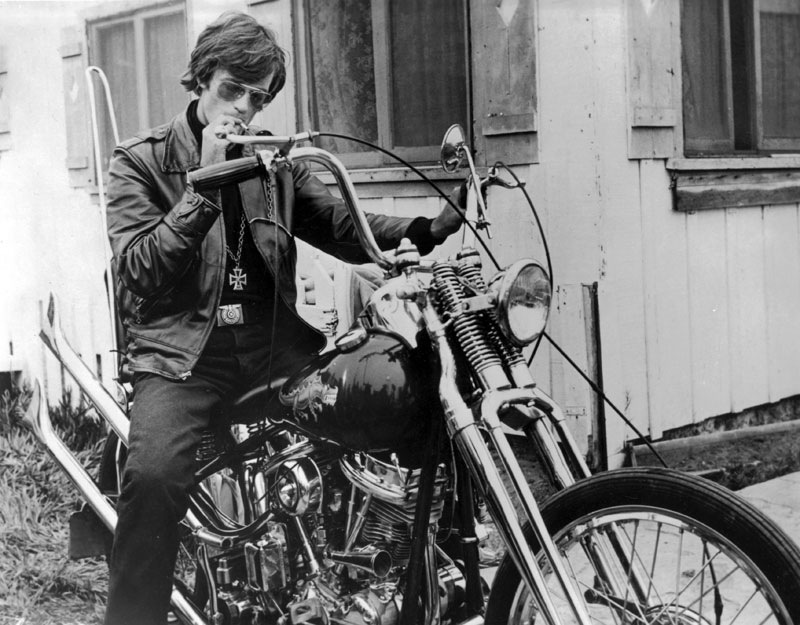
This is also the film that pushed Peter Fonda into the limelight as a counterculture hero. During the film’s release he was busted for possession, so he was in the front page of the papers right as the film came out, which used a picture of his character sitting on his chopper, taking a toke. This added legitimacy to his persona and certainly landed him future roles as a biker icon, despite being a more casual motorcyclist in real life than any of his characters.
Certainly, the film did better than other 1966 low-budget films like Billy The Kid vs. Dracula. Not every film is destined to live on forever.
In any event, The Wild Angels was a helluva film at the time and meant to be shocking, but by modern standards it makes its bones from the nostalgia of the locations it was shot, the period-correct bikes and looks, and some pretty cheesy dialogue, and is bolstered more by the talent that was featured in it.
If you have a rainy afternoon or it’s too damn cold to wheel the bike out for a ride, sitting down with this 1966 gem might be a good alternative.
Full Film on YouTube:
And remember, while I may have a long list of these movies to talk about, I’m always interested in hearing your favorite biker B-movie, especially something obscure that I may not have heard of. But share your biker B-movie favorites no matter what they are, or your last time at the drive-in theater. It’s a fading piece of Americana for sure, and there will only be so many more chances to see a film at the drive-in.
Also, I’m putting it right here in print with a ©… it’s a massively missed opportunity not putting charging stations for electric vehicles at drive-ins. While they can only show movies after dark, they could find other ways to keep motorists entertained in the daylight hours, earning money from charging as well selling a soda or a pizza or a movie ticket.
Electric car drivers need a place to kill a few hours during a charge-up? Stream them a movie into their car that they can’t get themselves, an sell ’em some popcorn while you’re at it. It’s a way to mash up the Americana of the drive-in with the future-forward thinking of alternative energy vehicles. I’m a genius, I know…
Sign up for the Weekly Digest if you’d like to get a Sunday morning email to help you kick off the day, straight from the Johnny Killmore Journal:
 Johnny Killmore
in the 60s i was in Kodiak Alaska. there was an exotic dancer there who later on i saw in a biker movie around 1966. the movie started with and introducing i believe her name was Cerlett Dercal
what was the name of that movie i was very good friends with her.
LikeLike
That isn’t a lot to go on, and the first big wave of biker exploitation flicks were hitting theaters in 1966-67, so there are a lot of releases at that time. The biggest is probably The Wild Angels with Nancy Sinatra and Peter Fonda as main characters, along with Dianne Ladd and Bruce Dern. Very few female characters had names besides the two main females and “Mamma Monahan” who had quite a few lines.
1966 Also had Satan’s Sadists, but I can’t remember a thing about that flick even though I’ve seen it. I’m almost positive She Devils On Wheels also came out in ’66. It was about an all-female biker gang and followed that low-budget, exploitation film format.
Motorpsycho has a female character who was a real life go go dancer. Russ Meyer discovered he in a club. Black hair, European accent, massive heaving chest, and one of the better blood-curdling screams of the 60’s exploitation era. Outside biker flicks there were a bunch of other exploitation films in that exact same era too: any excuse to get a flat stomach in a bikini onto a drive-in theater screen. I’m not at all an expert in all of those films. I mostly like biker flicks of all eras and teen-scare flicks about hot rodders, not specifically the exploitation stuff from the 60’s.
LikeLike
We used to go to all night biker movies back in the day at the drive-in. Horrible movies. Biker gangs on step-thru frames. Ape hangers on Honda Dreams.
LikeLiked by 1 person
Yeah there’s some really sad attempts in some movies. Others had enough budget to get 1-2 choppers and just put them in the front of every shot, with the little Japanese and East German stuff in the background. Eventually film makes and local bikers realized there was money in just paying extras who were local bikers. One source I saw for this particular film said the riders were paid $25/day as extras and paid $35/day for their bikes, which is a fine haul for the 1960’s. I think that’s a big part of this films ability to stand out nowadays: it wasn’t so low budget that they couldn’t film real bikers, real locations, and whoever did wardrobe didn’t make the stars look like cartoon characters
LikeLiked by 1 person