
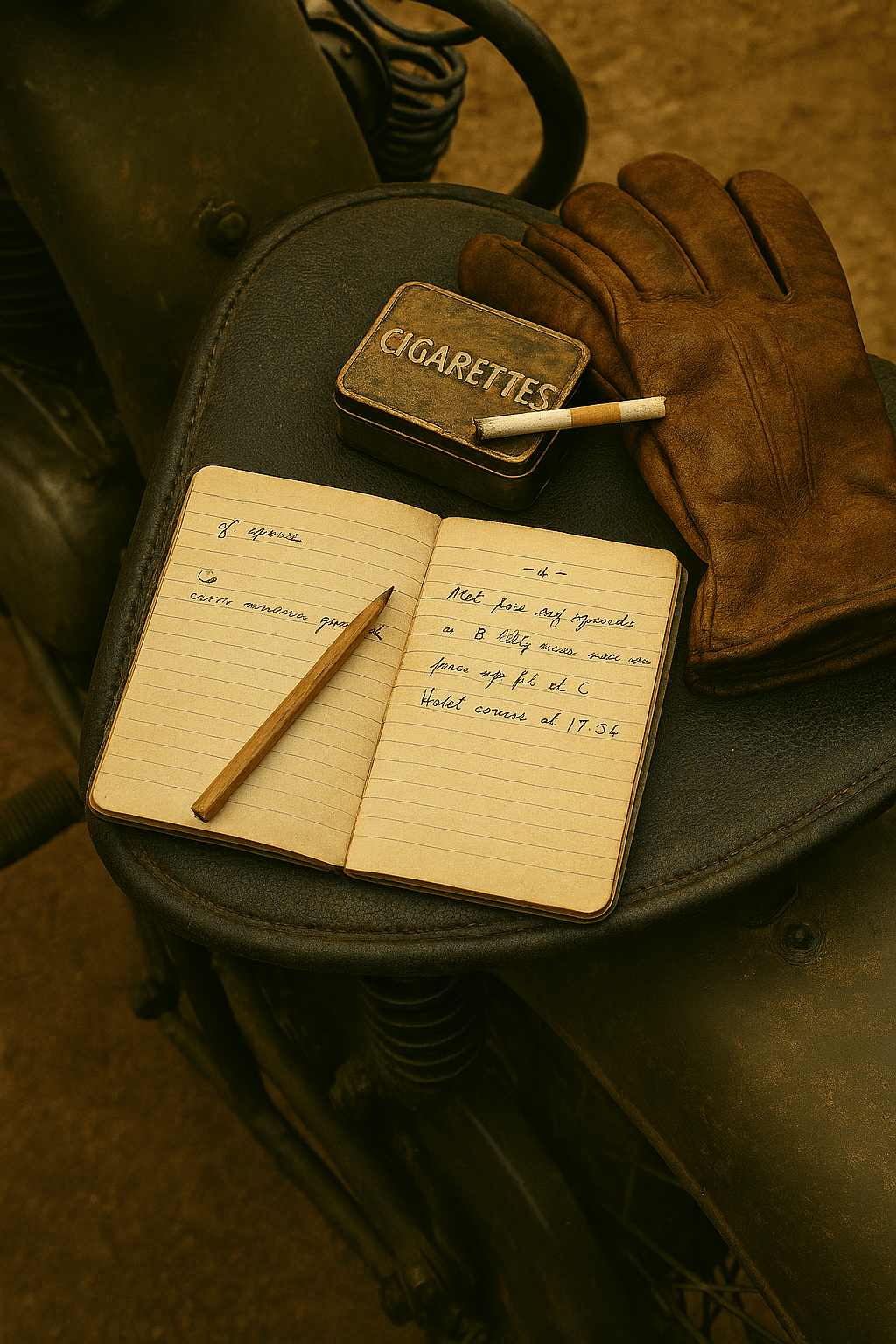
I keep putting off writing this recommendation because I want to finish the book first, but I can’t wait any longer. The Penguin’s Progress: Memoirs of a WWII Dispatch Rider in His Majesty’s Royal Air Force is just what it sounds like: the life and times of a young man doing a unique job during the war. Messages are still sometimes delivered by Dispatch to avoid enemy interception, but it was far more important in the 1940’s.
While generally moving between command elements behind the lines, messages often had to be sent to artillery units or other components that were within firing range of the enemy. And of course, there’s the chance an enemy plane could see your dust cloud from a great distance and strafe you from behind, with no way to hear them approaching over the wind and road of your engine (which happens to the author more than once).
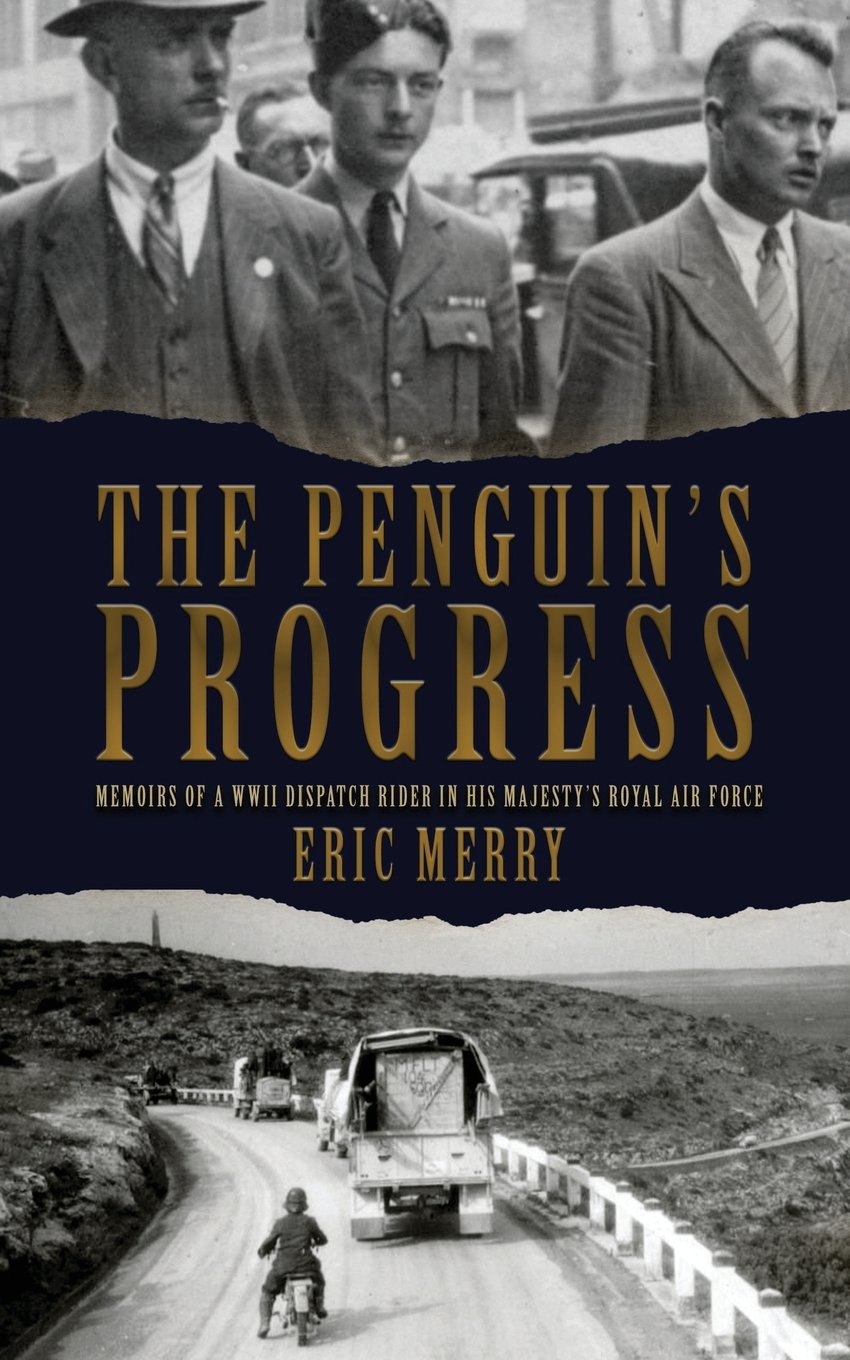
Eric Merry joined the RAF and was training to be an air gunner in England. His gunnery skills were excellent, but he couldn’t master the other part of the job: operating the wireless. Since he was working with coastal command his main duty would be as an observer looking for German U-boats and communicating their position, so while waiting to re-take the tests he killed some time by taking a two day dispatch rider’s course.
This would end up being hi lot for the war and he was shipped off to Africa during the campaign against General Rommel’s Desert Korps. What’s interesting about the book isn’t so much the motorcycling though, but that a dispatch rider is a unique type of job. Soldiers aren’t usually sent out on their own, which means a dispatch rider gets to see multiple commands, motor pools, barracks, and fighting positions.
That makes a dispatch rider a unique sort of person, since they are autonomous and can carry more than just message satchels direct from the rear command elements. Author Eric Merry does a great job of talking about the shenanigans he found himself in while on duty but also on his own time. He had the ability to scrounge up proper beds and wine or brandy, since he could mingle with well equipped units and civilians while hopping from place to place.
He also has the experience many soldiers only joke about: seeing the back of a sign that says “minefield.” If you see the back of the sign, it means you just came through one. Talk about getting the message late…
But despite searching burned out vehicles and nearly setting off booby traps and nearly being run over by tanks, Merry helps guide his unit as they move their base eastward across Africa as the British retreat. Acting as a scout for their convoy he sees nearly the whole width of the continent, and then sees it again as they push the Germans back.
He sees the unit’s Wellington bombers explode and burn on the flightline after ordnance is improperly loaded, has fellow dispatch riders killed, and he is thrown right over the handlebars multiple times at great speed because of the deep sands having impossible-to-detect soft spots. He is constantly in search of fuel, always trying to find a place to sleep while on the road, and goes through several different motorcycles in an effort to keep the messages moving.
I haven’t finished the book though so I can’t tell you the ending, but he does get posted to Italy after the Africa campaign wraps up. In a moment of perfect military logic he lands at the docks and is sent to find a location suitable to set up the command tents, except that he is still in his desert-issue gear and it’s late-fall. Why would anyone issue cold weather gear to people in the desert, right?
Fortunately he has some gear he can trade to some local tankers he encounters, and their cold weather gear keeps him alive long enough to complete his first scouting mission. That’s about where I left off. Despite loving the story, I don’t like reading books on my phone, but I bought this book on Kindle with a free credit. The digital copy is only $3.99 but at $9.99 I’d suggest the paperback, but that’s just me.
In either format, it’s the story that counts, and Eric Merry tells a great story (with Aubrey Wynn as co-author). I would expect that the few photographs in the book would display better in print though. As always, check your local library first as they may not only have a copy, but a digital copy you can check out virtually. It’s free, it’s easy, and libraries are a sadly under-utilized resource: one of the few things our tax dollars actually go to that’s directly useful, and so few people use it.

Once you have a library card, use the apps Libby or Overdrive to access ebooks, movies, music, and more. For free. Brooklyn’s library will give any New York resident a card, and anyone in the US ages 13-21 can get a card as part of their Books Unbanned initiative. Basically, the trick is to check the major city in your state. They probably have a free library card for state residents, and their online catalog will be much larger than your local library.
I keep a local library card for in-person use and then still have my San Francisco library card for digital use. Since I primarily listen to podcasts and audiobooks while on the road (music occasionally, but not usually while riding), the library is a great way to get access to new material but also the “heavy hitters.” I’d never have time to read all of George Orwell’s books, but when I found out how much non-fiction he wrote about his own life, I jumped at the chance.
His book Homage to Catalonia is about him fighting as a rebel in the Spanish Civil War. It’s an absolute gem. There’s the boredom and idiocy of the military life, compounded by how poorly organized a rebel army is, further compounded by him being in a unit of Englishmen inside of Spain. There’s the horror of trench warfare and the dangers of shelling and sniper fire. There’s even the political insanity as different rebel factions take control, making you a freedom fighter one day and a terrorist the next.
So there you go: you’ve got two books about the most amazing era of the 20th century. Both are accounts of war in a more realistic style, where it’s boredom and confusion and tedium, punctuated by brief moments of pure terror.
 Johnny Killmore
That one is on my list. Cool.
LikeLiked by 1 person